Dead trees are more than an eyesore. They are a serious hazard — especially on residential and commercial properties in Glendale, AZ. When a tree dies, its structure weakens quickly. Branches snap without warning. Trunks can fall in any direction. That is why tree removal with crane is the safest and most efficient solution for dead trees near homes, fences, pools, or power lines.
Arizona’s hot, dry climate takes a toll on trees year after year. Add monsoon season into the mix, and dead trees become urgent safety concerns. A crane-assisted removal keeps workers off unstable limbs. It also gives your crew precise control over where large sections land.
At Arizona Crane & Grapple, we specialize in exactly this kind of work. We serve Glendale and communities throughout the greater Phoenix area, including Peoria, Surprise, and Goodyear. If you have a dead tree on your property, this guide will help you understand your options and why a crane is often the right call.
Why Dead Trees Demand a Different Approach
Removing a living tree is one thing. Removing a dead tree is another challenge entirely. Dead wood is unpredictable. It can crack, split, or crumble under pressure. As a result, standard climbing and cutting methods become far more dangerous when the tree has already died.
In Glendale and across the Phoenix metro, many dead trees sit close to structures. Homes, block walls, utility lines, and vehicles are often nearby. Therefore, precision matters. A crane offers that precision — controlling every large section from the moment it is cut to the moment it lands safely.
Signs a Dead Tree Needs Immediate Removal
Not every dead tree looks obviously dangerous. However, several warning signs indicate it is time to act fast. Watch for these red flags on your property:
- Bark falling off in large sections — a sign of advanced decay
- Hollow or soft spots at the base — the root system may be compromised
- Leaning toward a structure or power line — an immediate hazard
- Brittle, leafless branches year-round — the tree is no longer viable
- Fungal growth at the trunk or roots — decay is progressing internally
If you notice any of these signs, do not wait. Furthermore, monsoon season in Arizona can turn a borderline-risky tree into a true emergency overnight. Acting early is always safer and often more cost-effective.
How Tree Removal with Crane Works
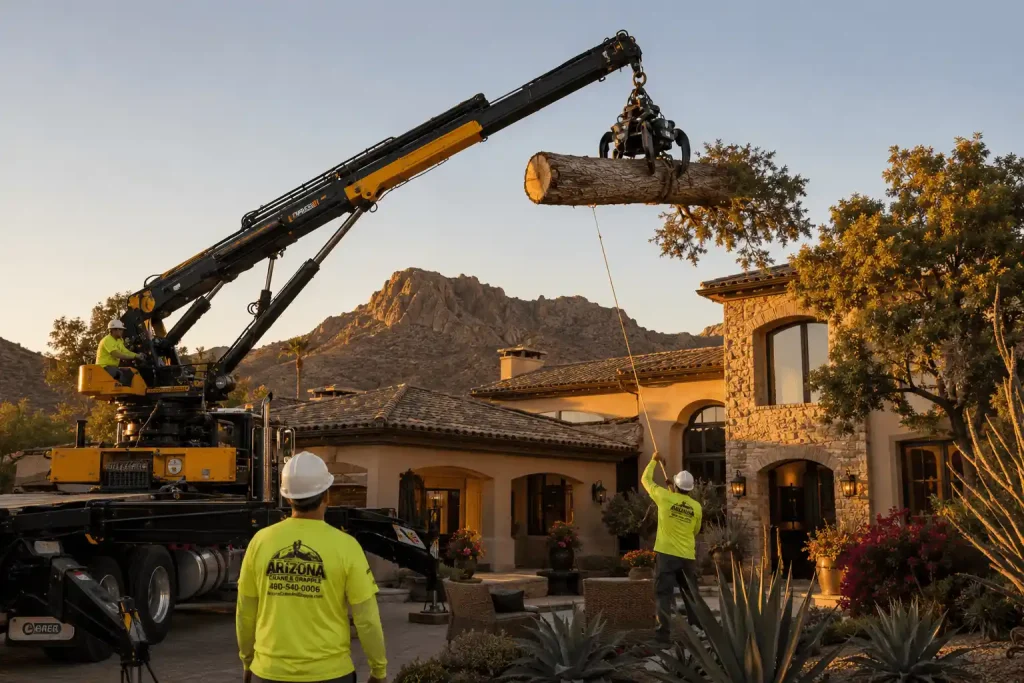
Crane-assisted tree removal is a highly coordinated process. First, our team assesses the tree, surrounding structures, and available access points. Then, we position the crane and establish a clear rigging plan before a single cut is made.
Our operator controls the crane from the ground. Meanwhile, a ground crew guides each section as it is lifted and lowered. This eliminates the need for workers to climb a structurally compromised dead tree. As a result, the entire operation becomes safer for everyone involved.
The Step-by-Step Crane Removal Process
Understanding what to expect can help you feel confident on removal day. Here is a general overview of how we approach crane-assisted dead tree removal in Glendale:
- Site assessment: We evaluate the tree’s condition, size, lean, and proximity to structures.
- Crane positioning: We select the best setup location to maximize reach and control.
- Rigging and attachment: Cables or straps are secured to the tree or large sections before cutting.
- Controlled cutting: Sections are cut and immediately held by the crane — no free-falling debris.
- Safe lowering: Each section is guided to a designated drop zone away from structures.
- Debris hauling: Our grapple truck loads and removes logs, branches, and debris efficiently.
Additionally, our team communicates constantly throughout the job. Every lift is deliberate. Every section lands exactly where it is planned to land.
When Is a Crane Necessary for Dead Tree Removal?
Not every tree removal requires a crane. However, several situations make crane assistance the clear best choice. In Glendale and nearby areas like Peoria and Surprise, we see these scenarios regularly.
Trees Near Homes and Structures
When a dead tree stands within falling distance of a home, garage, or block wall, a crane is essential. Traditional felling — cutting at the base and allowing the tree to fall — is not an option in tight spaces. Instead, a crane lifts each section straight up and away from the structure. This protects your property throughout the entire process.
Trees Near Power Lines
Dead trees near power lines are especially dangerous. Falling branches can knock out power, cause fires, or injure anyone nearby. Moreover, working around energized lines requires extreme precision. A crane provides the controlled lift needed to remove limbs and sections safely, without contact with surrounding infrastructure.
Large or Tall Dead Trees
Tall dead trees present significant logistical challenges. Furthermore, their height means more potential energy if something goes wrong during removal. A crane handles the weight of large sections that would otherwise be impossible to control manually. This is particularly common with mature trees — mesquite, eucalyptus, and block-busting ficus species found throughout the Phoenix area.
Limited Ground Access
Sometimes the layout of a property limits how crews can work around a tree. Pools, patios, narrow side yards, and fencing can all restrict movement. On the other hand, a crane can reach over obstacles and access sections that ground crews simply cannot safely reach.
Dead Tree Removal and Monsoon Season in Arizona
Arizona’s monsoon season runs from mid-June through September. During this period, powerful storms roll through the Phoenix metro with little warning. Dead trees are especially vulnerable. Because of this, many Glendale homeowners find themselves dealing with emergency removals after a storm event.
High winds can topple a dead tree in minutes. Additionally, saturated soil from monsoon rainfall weakens root systems that were already compromised. The combination can be devastating for properties that have been ignoring a declining tree.
Preparing Before Monsoon Season
The best time to remove a dead tree is before a storm arrives. Here are a few practical steps Glendale homeowners can take ahead of monsoon season:
- Walk your property and identify trees with dead or dying branches.
- Look for leaning trees, especially those angled toward your home or outbuildings.
- Check the base of large trees for soft spots, fungal growth, or visible decay.
- Contact a crane-assisted tree removal specialist to assess any trees that concern you.
Furthermore, proactive removal is almost always less expensive and less stressful than emergency cleanup after a storm. Do not wait until the wind makes the decision for you.
Talk with an experienced Arizona crane and grapple specialist at Arizona Crane & Grapple by calling (480) 470-1604 before monsoon season arrives.
Grapple Truck Services After Crane Removal
Once the crane brings dead tree sections to the ground, the work is not finished. Large logs, heavy limbs, and scattered debris still need to be loaded and hauled away. That is where our grapple truck service comes in.
A grapple truck uses a hydraulic claw to grab and load heavy material quickly. This is far faster than hand-loading debris. Moreover, it protects your landscaping by eliminating the need for workers to drag heavy logs across your lawn or hardscape. In Glendale and across the greater Phoenix area, our combined crane and grapple approach completes jobs efficiently from start to finish.
Frequently Asked Questions About Crane Tree Removal in Glendale
Is tree removal with crane safe for my property?
Yes — in fact, crane-assisted removal is often the safest option for dead trees near structures. The crane controls each section from the moment it is cut to the moment it is set down. This prevents uncontrolled falls that could damage your home, fencing, or landscaping.
How do I know if my dead tree needs a crane?
If the tree is large, located near a structure or power line, or if access to the area is restricted, a crane is likely necessary. Additionally, if the tree is severely decayed, climbing is unsafe — making crane removal the only responsible choice. Contact Arizona Crane & Grapple for a site assessment.
Do you serve areas outside of Glendale?
Absolutely. We serve Phoenix, Peoria, Surprise, Goodyear, and communities throughout Arizona. Whether your property is residential, commercial, or rural, our team brings the right equipment to handle the job safely.
What happens to the wood and debris after removal?
Our grapple truck loads and hauls all debris from the site. We handle everything from large logs to scattered branches. As a result, your property is left clean and clear after the job is complete.
Can you handle emergency dead tree removal?
Yes. We provide emergency tree services for situations that cannot wait. If a dead tree has fallen or is at immediate risk of falling — especially after a monsoon storm — call us right away at (480) 470-1604.
Contact Arizona Crane & Grapple for Dead Tree Removal in Glendale
Dead trees do not get safer with time. In Glendale’s desert climate, they dry out, decay, and become more unpredictable every season. Whether your tree is close to your home, leaning toward a fence, or simply too large to remove safely without specialized equipment, Arizona Crane & Grapple is ready to help.
Our experienced operators use advanced crane and grapple equipment to handle jobs that standard tree crews cannot manage safely. We protect your property, your family, and your neighbors throughout every step of the process.
To get started, contact Arizona Crane & Grapple today to request a fast estimate. You can also call us directly at (480) 470-1604. We proudly serve Glendale, Phoenix, Peoria, Surprise, Goodyear, and communities across Arizona.
Article created by Atomic Social Workspace.